Nineteen Sixty-four is a research blog for the Center for Applied Research in the Apostolate (CARA) at Georgetown University edited by Mark M. Gray. CARA is a non-profit research center that conducts social scientific studies about the Catholic Church. Founded in 1964, CARA has three major dimensions to its mission: to increase the Catholic Church's self understanding; to serve the applied research needs of Church decision-makers; and to advance scholarly research on religion, particularly Catholicism. Follow CARA on Twitter at: caracatholic.

8.13.2021

The Most Valuable Rolex No One Can Ever Buy… But It Could Be Gifted?

Saint John Paul II was not someone who was known to aspire for or use luxury goods. Yet, he would come to have one remarkable possession that was a constant companion during his papacy. Rumored to be a gift from Rolex this was a 36 mm steel and yellow gold Datejust on a jubilee bracelet with a champagne dial. Many world leaders have similar or far more expensive watches. The Dali Lama also wears a similar piece as did Rev. Martin Luther King Jr. Several U.S. presidents have worn a Rolex gold Day-Date on a presidential bracelet. 


At retail in 1978, the former Pope’s Datejust, reference 16233, would have cost $1,260. In 2021 dollars that would be equivalent to spending $5,276 on a watch (good used examples from this time cost $6,500 to $7,500 today). The most affordable new Rolex today will cost you $5,700 at retail. If you went to a Rolex dealer to buy a new version of the watch worn by Saint John Paul II it would cost $11,700. Then the magic begins. When buying a Rolex at retail today this puts one in a rare economic circumstance—the item you buy grows in value as it leaves the store. You could then “flip” it selling it to someone for $13,500. This is due to limited production of pieces and the difficulty in getting an authorized dealer willing to sell to you, which is impossible if they think you are going to flip the watch after purchase.

The world of Rolex and watch collecting has experienced phenomenal growth in the asset bubbles of recent years. When a Rolex that was worn by some notable public figure comes on the market one can throw economic fundamentals completely out the window. Rising well above all others, at $17.8 million is Paul Newman’s Rolex Daytona, which had been a gift from his wife (inscribed “Drive carefully. Me”). In 2015, astronaut David Scott’s personal Bulova watch, which he wore on the moon, was auctioned off for $1.6 million. Astronauts are supplied Omega Speedmasters for spaceflights by NASA. Buzz Aldrin sent his moon worn piece to the Smithsonian and to this day no one can locate it. This is probably one of the most valuable watches that no one knows the whereabouts of.  

That brings me back to the Rolex worn by Saint John Paul II. In his will he wrote, “I leave no property behind me of which it is necessary to dispose. As for the everyday objects that were of use to me, I ask they be distributed as seems appropriate.” That Rolex was likely one of those “everyday objects” and with the Pope becoming a saint in 2014, the watch became a second-class relic. Church law states, “Can. 1190 §1. It is absolutely forbidden to sell sacred relics.” However, these can be given away by owners and in rare circumstances could be bought from someone to save them from destruction or desecration.

I have been trying to research what happened to the two-tone Datejust after the death of Saint John Paul II. I can’t find any record of what happened to it or where it is today. Given what has happened in the Rolex world in recent years and the incredibly notable person who wore this piece I imagine it is one of the most important and valuable watches in Rolex’s history—especially if it was indeed a gift from the company.

Pope Emeritus Benedict XVI was often seen wearing a German 42 mm Erhard Junghans Tempus Automatic. He received it as a gift from a German politician, Volker Kauder. You can find one today for about $2,000 previously owned. It has Roman numerals on the dial and there is a IIII at four instead of IV. There seems to be no consistent history about how this became a custom first on clocks and then on watches. One of the most likely theories is that it was just easier for people reading a town clock hundreds of years ago to add the four bars rather than subtract I from V.

Pope Francis wears a resin quartz Casio MQ24-7B2, which sells for about $15 to $20 at Wal-Mart. He likely purchased this himself (probably not from Wal-Mart). Casio has confirmed that the watch was not a gift from them and I think it would be unlikely for someone else to give the Pope a $15 watch. Casio wasn’t even aware that Pope Francis was wearing something from their brand. On this Casio perhaps the most interesting thing is that the numeral font on the dial is Handel Gothic. This was designed for the Warner Brothers Studios logo in the 1970s and can be seen in the credits for Sesame Street. Perhaps most famously it was used as the font in materials for the film Close Encounters of The Third Kind.

Popes prior to Saint John Paul II didn’t regularly wear a watch or seemed to favor pocket watches over wrist watches. In the watch world one of the most famous categories of desirable watches are moon-worn pieces or watches just worn in space. One can now perhaps add pope watches (for more on this: 1, 2, 3, 4) as a category and this collection currently contains three pieces from a very affordable Casio to a nice German Roman numeral watch and finally a two-tone Rolex of unknown working condition or location. Still looking… In watch collecting people call the watch they want to own the most a “grail watch.” I don’t want to own this relic but it would be very interesting to know where it is today.


3.19.2021

U.S. Catholics Adapting to New Realities

At CARA, we utilize our surveys and Google search term trends to estimate weekly Mass attendance. Mass attendance fell to below 10 percent during Lent in 2020 with the emergence of the pandemic. Did former weekly attenders begin to watch Mass weekly online or on TV? Has Mass attendance begun to increase now as vaccines are administered and lockdowns eased?

A CARA survey conducted during the summer of 2020 of young adult Catholics (ages 18-35) indicated 11% were watching Mass "very often" and 14% were viewing "somewhat often." According to our tracking of Google search trends, this matches what we might call "Mass participation." The figure below shows how Mass attendance changed with the green bars approximating attendance and the orange bars estimating viewing. 

While in-person attendance has been difficult, Mass participation or engagement has been more consistent. Prior to the pandemic about 27% of Catholics were attending or viewing Mass per week. This would rise significantly on days of obligation and Ash Wednesday. During the pandemic engagement has averaged 22% per week. Yet, this does not rise as much on days of obligation and Ash Wednesday (for more on Mass attendance trends see our previous post). 

In the aforementioned survey of young adults, 30% said they lived in a household that contributed financially to their parish's weekly offertory collection, giving, on average, $10 per week prior to the pandemic. Since the beginning of the pandemic, only 13% say their household has been contributing. However, among these households, the average given per week has been $20 per week (for more on financial giving see our previous post).

According to Gallup, affiliation with Catholicism in 2020 was 22% and this was unchanged from what it was in 2019 or 2018. 


2.08.2021

Ponderings on mortality…

This post is from CARA's Executive Director Thomas Gaunt, S.J.

This coming year I will mark 50 years as a Jesuit having entered the Maryland Province of the Society of Jesus in 1971 at a time when the Province infirmary was located at the novitiate in Wernersville, PA.  The brothers and priests in the infirmary seemed ancient of age – they were in their 70s and 80s at a time when most American men lived only into their late 60s, and Jesuits even less.  A remarkable achievement over the past 50 years has been the extension of life expectancy – particularly for men, and for Jesuits, in the United States.

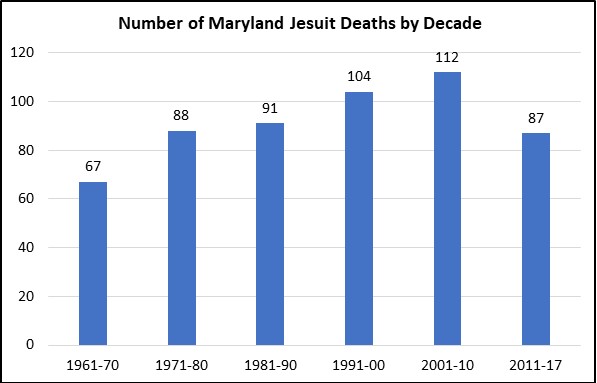
The life expectancy for white American males in 1970 was 68.0 years and it would steadily increase year after year to 76.4 years by 2017 (the most recent data).  An 8.4 year increase in longevity over a period of 47 years.  An examination of the necrology of the Maryland Province Jesuits (a listing of all the deceased Maryland Province Jesuits that is maintained so that we might remember them in prayer on the anniversary of their death) shows that the average age of death between 1961 to 1970 was 66.2 years.  In 1970 the Jesuits had an average life span of about 1.8 years less than other men.

If we fast forward to 2017 the average age of death for Maryland Jesuits had increased to 83.7 years, or 7.3 years more than other men.  What is happening here?  The following graphs show the number of Jesuits who died in each decade and their average age at death.  The Center for Disease Control calculates the life expectancy for men and women by ethnicity each year - the life expectancy at the end of each decade is presented in the table below.  An actuarialist will note that these are not exactly comparable calculations, but they are close.


In 1970 the Maryland Jesuits were living 1.8 years less than other American males and this increases to 2.5 fewer years by 1980.  Jesuit longevity then reverses itself by 1990 when Jesuits are now living just over a year longer (1.2 years) and begins to steadily increase to 2.1 years in 2000, 5.9 years in 2010, and 7.3 years in 2017. While the life expectancy for American men increased by about 8 ½ years between 1970 to 2017, the Maryland Jesuits increased their longevity 17 ½ years, double the average gain of American men over the same 47 years.

In recent years there were major studies on the relationship of one’s marital status to longevity, in 2006 in the Journal of Epidemiology and Community Health there was an article “Marital Status and Longevity in the United States Population” by Robert Kaplan and Richard Kronick.  They investigated the relation between marital status and longevity.  They summarize their research findings saying, “controlling for demographic and socioeconomic characteristics, the death rate for people who were unmarried was significantly higher than it was for those who were married and living with their spouses. Although the effect was significant for all categories of unmarried, it was strongest for those who had never married. The never married effect was seen for both sexes, and was significantly stronger for men than for women.”  Concluding that “current marriage is associated with longer survival. Among the not married categories, having never been married was the strongest predictor of premature mortality.”

So, what might be going on here?  Jesuits (who are never married) are living considerably longer that other U.S. males (married and single), and even longer in comparison to single never married men. Kaplan and Kronick pay particular attention to the social isolation that may occur with those who are never married.  They write:

Accumulated evidence suggests that social isolation increases the risk of premature death. Marriage is a rough proxy for social connectedness. Among categories on being unmarried, we suggest that having never married may be associated with more severe isolation because it is associated with greater isolation from children and other family. The data seem to support the hypothesis that the greater level of social isolation associated with having never married is associated with larger health consequences….

Our study raises a series of new questions. Firstly, we found that having never been married is a better predictor of poor health outcomes than either divorce or widowhood. Secondly, the impact of social isolation is not constrained to the elderly. In fact, it is comparatively stronger early in life. This phenomenon may have been overlooked in previous studies because early death is uncommon…. Finally, our findings challenge the belief that the effect of social isolation is upon diseases of the heart. Our findings underscore the impact on all cause mortality. Furthermore, the predominant cause of death associated with social isolation differs at different stages of the life cycle.

Kaplan and Kronick’s conclusion that having never been married impacts the longevity of men fits the Jesuit data in the 1960s and 70s when Jesuit longevity was 1.8 to 2.5 years less than other men.  But, from the 1980s on the reverse has occurred as the never married Jesuits increase their longevity over other men by more than 7 years by 2017. 

For the Jesuits of the Maryland Province, and the Jesuits throughout the world, there was a renewed focus on the importance and value of community life in the late 1960s and 70s.  A change of customs and habits in the day to day living of Jesuit life together did not come quickly or without turmoil, but greater attention to how we share life together, both in prayer and in conversation, along with support for one another has evolved over the decades.  Greater attention was also given to the use of tobacco and alcohol (important factors for healthy living).

In 2016 at the Jesuit General Congregation this renewed focus on community life was stated as: “The Jesuit community is a concrete space in which we live as friends in the Lord. This life together is always at the service of mission, but because these fraternal bonds proclaim the Gospel, it is itself a mission.” (GC36, D. 1, No. 9) To be “friends in the Lord” is a renewed part of the mission of Jesuits in recent decades – quite the opposite of social isolation.

Community life in the Jesuits, or just about any Religious Institute, not only counteracts the harmful impact of social isolation for those who never marry, but may well enhance the benefits of social connectedness for longevity.   

References:

Kaplan, R. M., & Kronick, R. G. (2006). Marital status and longevity in the United States population. Journal of epidemiology and community health, 60(9), 760–765.  www.ncbi.nlm.nih.gov/pmc/articles/PMC2566023/

National Center for Health Statistics. Health, United States, 2018. Hyattsville, Maryland. 2019.  Table 4. Life expectancy at birth, at age 65, and at age 75, by sex, race, and Hispanic origin: United States, selected years 1900–2017.  www.cdc.gov/nchs/hus/contents2018.htm#Table_004

Documents of General Congregation 36 of the Society of Jesus.    Decree 1, No. 9.  hthttps://jesuits.eu/images/docs/GC_36_Documents.pdf

Search This Blog

Blog Archive

© 2009-2026 CARA, Mark M. Gray. Background image courtesy of muohace_dc.